
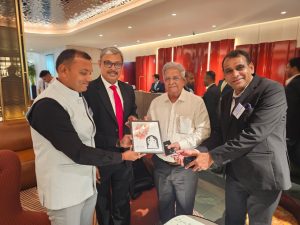
Shri Kanubhai Mohanlal Desai, Hon’ble Finance Minister of Gujarat During Indian Business Delegation to London
Reflections from London: Why the India–UK Business Delegation Marks the Beginning of a New Chapter for Indian MSMEs and Gujarat:
When I got the opportunity to be part of the India Industry Delegation to the United Kingdom, accompanying the Hon’ble Union Minister for Commerce & Industry, Shri Piyush Goyal, I considered it as responsibility to represent the aspirations of Gujarat’s entrepreneurs, India’s MSMEs, and the growing confidence of Indian industry on the global stage. The Delegation was organized under the Ministry of Commerce & Industry, Confederation of Indian Industries and FICCI bringing leading business personalities across from India together.
It was a gratifying experience for me to see my profile included in the official FICCI Delegate Profiles booklet as Chairman – Gujarat, India Commonwealth Trade Council, representing ICTC Gujarat among India’s business leadership, and what made this more admirable that it highlighted the work of ICTC Gujarat has undertaken to strengthen MSMEs, promote exports, and build international partnerships.
However, what truly matters is objectivity, what we learnt, whom we connected with, and how those learnings can benefit thousands of businesses in Gujarat when i am back to home, just not the inclusion of a profile in a booklet.
The first observation I would like to highlight from the delegation which boosted my confidence and national pride is;
India Is No Longer Looking for Markets, India Is Building Partnerships.
I observed during interaction with participants from UK and specially my interaction with The Rt Hon. Lord John Mann & Ms Jo White MP World and global businesses are looking at India with a complete paradigm shift.
For World India is now;
- A trusted manufacturing partner,
- An innovation hub,
- A technology collaborator,
- A resilient supply chain,
- One of the world’s fastest-growing consumer markets.
This shift reflects the remarkable transformation which India has undergone over the past decade.
The impact of this shift was quite evident in every interaction with policymakers, business leaders, investors, trade organizations, and institutional partners.
The second observation that I derived from this delegation is;
The India–UK Partnership is much more than trade.
In general perspective it is perceived that trade agreements are only relevant for the large corporations but my experience in London convinced me otherwise.
The evolving India–UK partnership has the potential to create opportunities for every ambitious MSME ready to compete globally, and this can inferred from the report prepared by FICCI – Pathways to Prosperity THE EVOLVING INDIA–UK PARTNERSHIP June – 2026, which describes the partnership between India & UK an opportunity of cooperation around multiple areas including healthcare, defence and aerospace, advanced manufacturing, digital technologies, clean energy, education, tourism, professional services and innovation.
These opportunities will not be limited to exporters only, it will be extended to;
- manufacturers,
- service providers,
- technology companies,
- startups,
- educational institutions,
- consulting firms,
- logistics companies,
- innovation ecosystems,
- skilled professionals.
For Gujarat, whose entrepreneurial culture is deeply rooted in entrepreneurship, manufacturing and commerce, this creates an extraordinary window of opportunity.
The third observation I derived during the business delegation is businesses across UK want relationships that go beyond transactional buying and selling. They seek partners capable of building long-term value and that is precisely where Indian entrepreneurs have a natural advantage because;
- We are resilient,
- We innovate under constraints, pressures & limitations,
- We think for long term,
- We are being quality centric and becoming globally competitive.
The fourth observation and my biggest takeaway from this delegation is;
Relationships make trade before contracts do because international business begins with trust not with quotations.
Trade agreements may reduce tariffs, governments may create favorable policies, industry associations may organize delegations But ultimately, business happens between people.
During the visit, I realized it deeply during meaningful conversations over meetings, networking sessions and institutional interactions which often create opportunities that no email campaign can ever generate.
This reinforces a philosophy that I have been following up consistently At ICTC Gujarat.
Economic diplomacy is not only the responsibility of governments. It is a collective responsibility and Industry institutions also play a vital role in creating trusted bridges between businesses across countries.
The final observation and realization I learnt with this delegation visit is;
Why and How ICTC Gujarat emerge to be more relevant and meaningful for Gujarat and its MSME & Export Ecosystem;
This visit strengthens my conviction that Commonwealth is and represents a network of economies connected by shared institutions, language, legal systems and historical ties and for Indian MSMEs, this provides an excellent platform to expand globally in partnership with India Commonwealth trade Council Gujarat Since ICTC has proven expertise over;
- promoting export awareness,
- facilitating international business connections,
- supporting MSMEs entering overseas markets,
- building relationships with foreign institutions,
- encouraging policy dialogue,
- creating opportunities for international collaboration.
To know more about ICTC – Gujarat and its activities you reach us on secretariat-gujrat@indiacw.in
What impressed me most during the delegation: –
During the visit there were several moments stood out but few them impressed me with a very soothing effect and they are;
- The professionalism of British institutions,
- The structured approach towards innovation,
- The willingness to collaborate with Indian enterprises,
- The growing respect for India’s manufacturing capabilities.
I express my thanks and gratitude to FICCI and Laghu Udyog Bharti for considering me as delegation member and look forward to attending such more meaningful delegations in future.